





If you're homeschooling through high school or parenting a student who is, you already know how much you can accomplish when learning fits your life instead of the other way around. So here's something else worth knowing: that same flexibility opens the door to one of the biggest college advantages out there — earning college credit before you ever set foot on a campus.
Students who strategically earn credit during high school can start college with credit. That means lower tuition costs, a faster path to a degree, and a transcript that signals to admissions offices that you're ready for college-level work. The options for doing this have expanded significantly in recent years, and they're genuinely accessible to homeschool families.
Here's an honest look at how it works, which paths make the most sense for different learners, and how to put together a plan that actually pays off.
Why Bother Earning College Credit Early?
First thing first — is it worth it earning college credit early?
The most obvious benefit is that you can save money. College is expensive, and every credit you earn in high school is one you don't have to pay for later at full tuition rates. Depending on how many credits you accumulate, you could realistically knock an entire semester — or even a full year — off your undergraduate education.
But it's not just about savings. Earning college credit while homeschooling gives you a chance to experience college coursework before you're fully committed. You get to see how you handle college-level assignments, pacing, and expectations with lower stakes. For students who've always worked independently, this transition may be easier than it is for traditionally schooled peers.
There's also the application angle. A student who has already passed college-level courses or exams arrives at admissions with concrete evidence of academic readiness. That's harder to dismiss than grades on a self-directed homeschool transcript alone.
Option 1: Dual Enrollment
Dual enrollment is exactly what it sounds like: you enroll in an actual college course and receive credit from both the institution and (in some cases) toward your high school requirements simultaneously. Many community colleges and some four-year universities have formal programs for this, and homeschool students are typically eligible.
The credit you earn is real college credit, transcripted by the institution and often accepted by other colleges when you transfer or enroll. Eligibility requirements vary, but most programs ask for a minimum GPA equivalent, test scores, or a placement exam. Some states have laws that make dual enrollment accessible and even subsidized for homeschool families.
The main limitations are geographic and scheduling. You usually need to be near a participating college, and the course schedule is fixed. If your family's schedule doesn't conform to a fixed class time three mornings a week, dual enrollment can be a logistical challenge.
Option 2: Online College Courses
Online college courses solve the problem dual enrollment often can't: scheduling.
With an online course from an accredited institution, you're not tied to a campus schedule or a geographic location. You do the work on your timeline, which fits naturally with how most homeschool students already operate. Perhaps the best part is that the credit is exactly the same kind you'd earn sitting in a classroom.
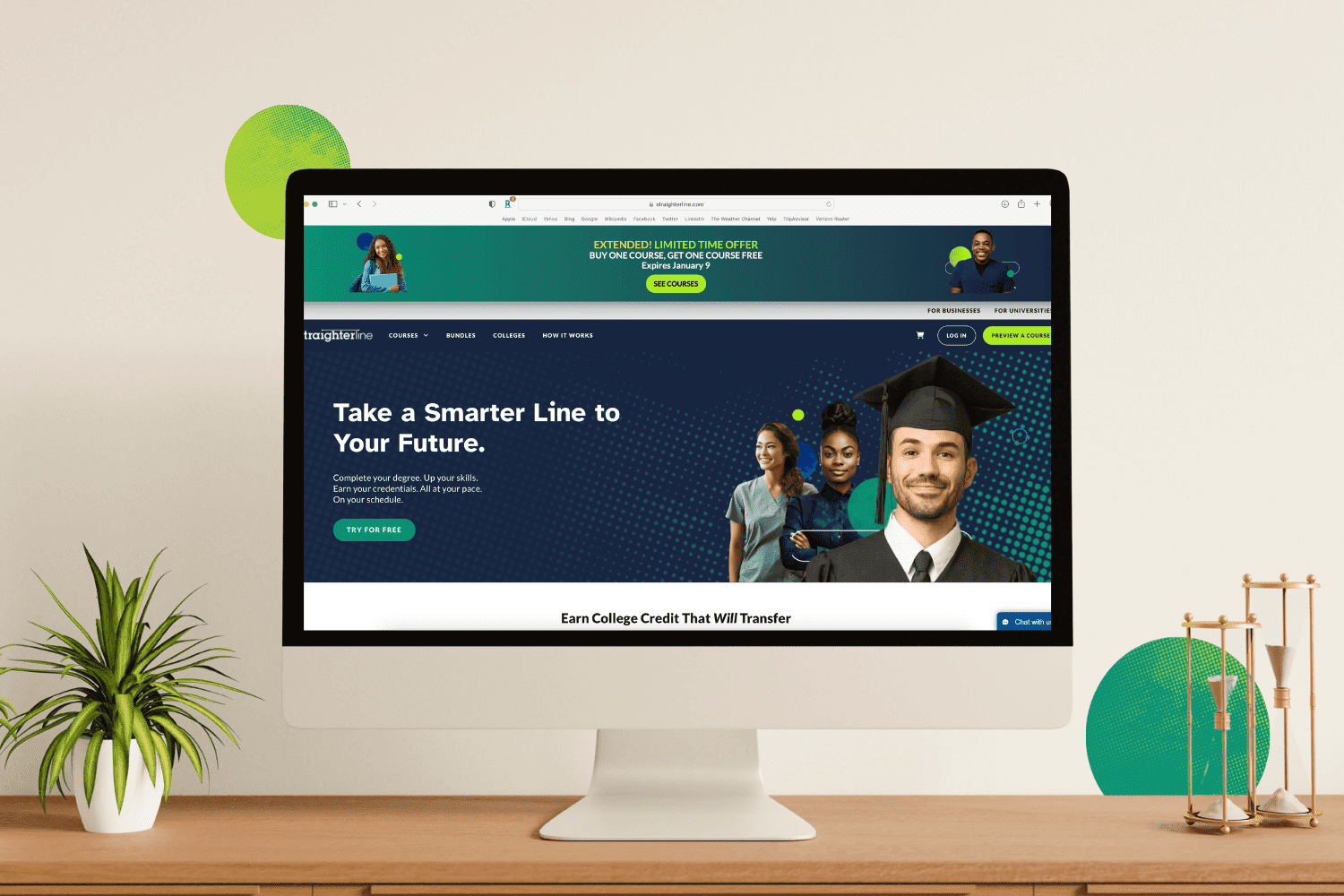
StraighterLine is one of the most well-established options in this space. Our courses are designed for independent learners who want college credit without the overhead of traditional enrollment, and we’ve built partnerships with hundreds of accredited colleges and universities to make sure that credit actually transfers.
If you're looking for a starting point, our general education course catalog covers the foundational subjects most students need anyway — English Composition, College Algebra, Introduction to Psychology, and dozens more. Our online college course model is a great fit for students who already work independently.

Option 3: CLEP Exams
The College-Level Examination Program, run by College Board, lets you demonstrate mastery of a subject through a single proctored exam. Pass the exam, typically with a score of 50 or above, and many colleges will award you credit for that subject without requiring you to take the course.
CLEP exams cover 34 subjects, from introductory science to history to foreign languages. Each exam costs around $100, which makes it one of the most affordable ways to earn credit if you already have strong knowledge in a subject area. Some homeschool students find that their deep dives into particular subjects have already prepared them for a CLEP exam with relatively little additional study.
The catch is that not every college accepts CLEP credit, and those that do often have restrictions on which exams they'll accept and what scores they require. Before planning around CLEP, check the specific transfer policies of the schools on your list.
Option 4: AP Courses and Exams
Advanced Placement is the option most students already know about. You complete a rigorous, college-level course and then sit for a standardized exam in May. Scores of 3, 4, or 5 may earn you college credit, though the policies may vary from one school to the next.
For homeschool students, AP courses are available through a variety of online providers and self-study routes. You don't need to be enrolled in a traditional school to sit for the exam! You just need to register through a local testing center.
Option 5: Community College Courses
Community colleges are one of the most practical credit-earning options available. Tuition is low, many offer online sections, and the credits transfer broadly to four-year institutions, especially within the same state system.
Taking a course directly at a community college (in-person or online) gives you a familiar, accredited transcript entry that most admissions offices and transfer advisors understand immediately. It's also a good option for subjects that are hard to assess through a single exam, like writing-intensive courses or lab sciences.
Choosing the Right Path
There's no single best answer here — it depends on how you learn, what your budget looks like, and where you're hoping to end up. A few questions to ask yourself:
How do you work best? If you're self-directed and prefer setting your own pace, online college courses or CLEP might be your best fit. If you do better with more structure and real-time interaction, dual enrollment or community college courses might suit you more.
What are your target colleges' policies? This is the most important question of all. Before investing time in any credit-earning strategy, look up the specific transfer credit policies of the schools you're considering. Some accept CLEP and AP credits generously while others are strict.
Thinking about StraighterLine courses? Take a look at our Colleges page to find if your institution accepts our courses.
What subjects do you need? If you know you'll need to satisfy a math or science requirement, earning that credit early through an online course or CLEP makes obvious sense. If you're still exploring what you want to study, a broader online course catalog gives you more room to test different subjects at low cost.
A Sample Four-Year Credit Plan
This is the kind of concrete roadmap that most articles skip over, so let's walk through what this could actually look like.
Freshman Year (9th Grade): Focus on foundational subjects and identify two or three areas of academic strength. Begin researching which colleges interest you and what their credit transfer policies are. If you're a strong reader and writer, consider preparing for a CLEP exam in English Composition.
Sophomore Year (10th Grade): Take one or two online college courses in subjects you're confident about (e.g. something like Introduction to Psychology or College Algebra). These are low-pressure ways to get real college credit and see how you handle the format. Even one course per year adds up.
Junior Year (11th Grade): Ramp up. This is a good time to take two to three courses, either online, through dual enrollment, or a combination. You might also sit for one or two AP exams if you've been studying those subjects.
Senior Year (12th Grade): By now you should have a clear picture of where you're applying. You may use this year to fill gaps with targeted credit in subjects you know your top school will require. You can also complete any remaining dual enrollment or online courses. Going into college with 15–20 credits already in hand is entirely realistic if you've been consistent.
Read more: Can HomeSchool Students Take College Courses?
Will Colleges Actually Accept These Credits?
Yes! Although you do need to check with your institution ahead of time.
What matters most isn't where a course comes from — it's whether the college you're heading to will accept it. That's a function of quality, recognition, and established partnerships rather than a single accreditation stamp.
StraighterLine courses, for example, are recommended by the American Council on Education (ACE) and have transfer agreements with hundreds of colleges and universities.
That said, no credit-earning strategy is one-size-fits-all. Before you enroll in anything with transfer credit in mind, check the specific policies of the schools on your list. Contact the admissions or registrar office directly and ask about each type of credit you're considering. Policies can and do change, so getting confirmation in writing is worth the extra step.
Frequently Asked Questions
Can homeschool students enroll in dual enrollment programs? Yes, in most states. Many community colleges and universities specifically accommodate homeschool students, and some states have laws ensuring access. Requirements vary — check with local institutions and look into your state's homeschool association for guidance on what's available in your area.
What's the most affordable way to earn college credit before high school graduation? CLEP exams are the lowest upfront cost at around $100 per exam. Online college courses through providers like StraighterLine offer affordable per-course pricing that's significantly less than traditional college tuition, especially for general education requirements.
Do all colleges accept credits earned by homeschool students? Many accredited colleges will consider college-level credit regardless of how you earned it — what matters is the source. Credits from accredited institutions, recognized exam programs like CLEP and AP, and established online providers with credit transfer partnerships are widely accepted. Always verify with your specific target schools before enrolling.
How many college credits can a high school student realistically earn? This varies, but a motivated student could reasonably accumulate 15–30 credits over the course of high school through a combination of approaches. That's roughly one full semester of college completed before you officially begin.
Are online college courses as respected as in-person ones on a transcript? From a transfer credit standpoint, what matters is the accreditation of the institution offering the course rather than the delivery format. Online courses from accredited providers are treated the same as in-person courses by most colleges and universities.
Start Earning College Credits Today
Earning college credit in high school is one of the smartest moves a homeschool student can make, and it's more accessible than most families realize. Whether you're drawn to the flexibility of online courses, the affordability of CLEP exams, or the structure of dual enrollment, there's a path that fits how you work.
Explore StraighterLine's online college courses to find transfer-friendly options that fit your schedule, your goals, and your pace. It's one of the most practical steps you can take right now toward a smarter, more affordable college experience.