






If you've ever taken a class at one school and worried it might not count at the next one, you already understand the anxiety that comes with transferring. It's one of the most common questions students ask before enrolling anywhere: will this credit actually count where I'm headed? The answer often comes down to something called a transfer articulation agreement.
An articulation agreement isn't a mysterious piece of academic paperwork. It's essentially a roadmap that two schools build together, spelling out which courses transfer, how they apply toward a degree, and what you need to do to qualify. Think of it as an agreement that removes the guesswork from your transfer plan, so you're not left hoping your credits will count after the fact.
In this article, we'll walk through what articulation agreements are, how they function in practice, the different forms they can take, and how you can use one to build a smarter, more affordable path toward your degree.
What Is a Transfer Articulation Agreement, Exactly?
As we started to explain above, an articulation agreement is a formal understanding between two educational institutions. They’re often drafted between a community college and a four-year university, or an online course provider (such as StraighterLine) and a degree-granting school to outline how eligible coursework from one institution will transfer and apply toward requirements at the other. Instead of leaving transfer decisions to chance or requiring a case-by-case review every time, the schools involved agree in advance on which courses are equivalent and how they'll count.
For you, that means less uncertainty and a lot less repeated coursework. Rather than discovering after the fact that a class doesn't apply to your new program, you can look at the agreement when you plan your course selections. These agreements exist because both students and institutions benefit when the transfer process is transparent.
How Do These Agreements Work?
Articulation agreements are built by the receiving institution (the school you're transferring into) and help clarify which courses from a partner school satisfy requirements in its own degree programs. A course from one school could either match a required course in another, count as an elective credit, or not count at all.
Most agreements include a handful of important details: which courses are eligible, how those courses equate to courses at the receiving school, any minimum grade you need to earn, which degree programs the agreement applies to, and sometimes a cap on how many credits can transfer in total. It's worth remembering that having an articulation agreement in place doesn't get rid of admissions requirements. You'll still need to apply, meet the receiving school's academic standards, and, in many cases, maintain a certain GPA. What the agreement does is give you clarity in advance about how your coursework fits into that picture, so you can make informed decisions rather than crossing your fingers later.
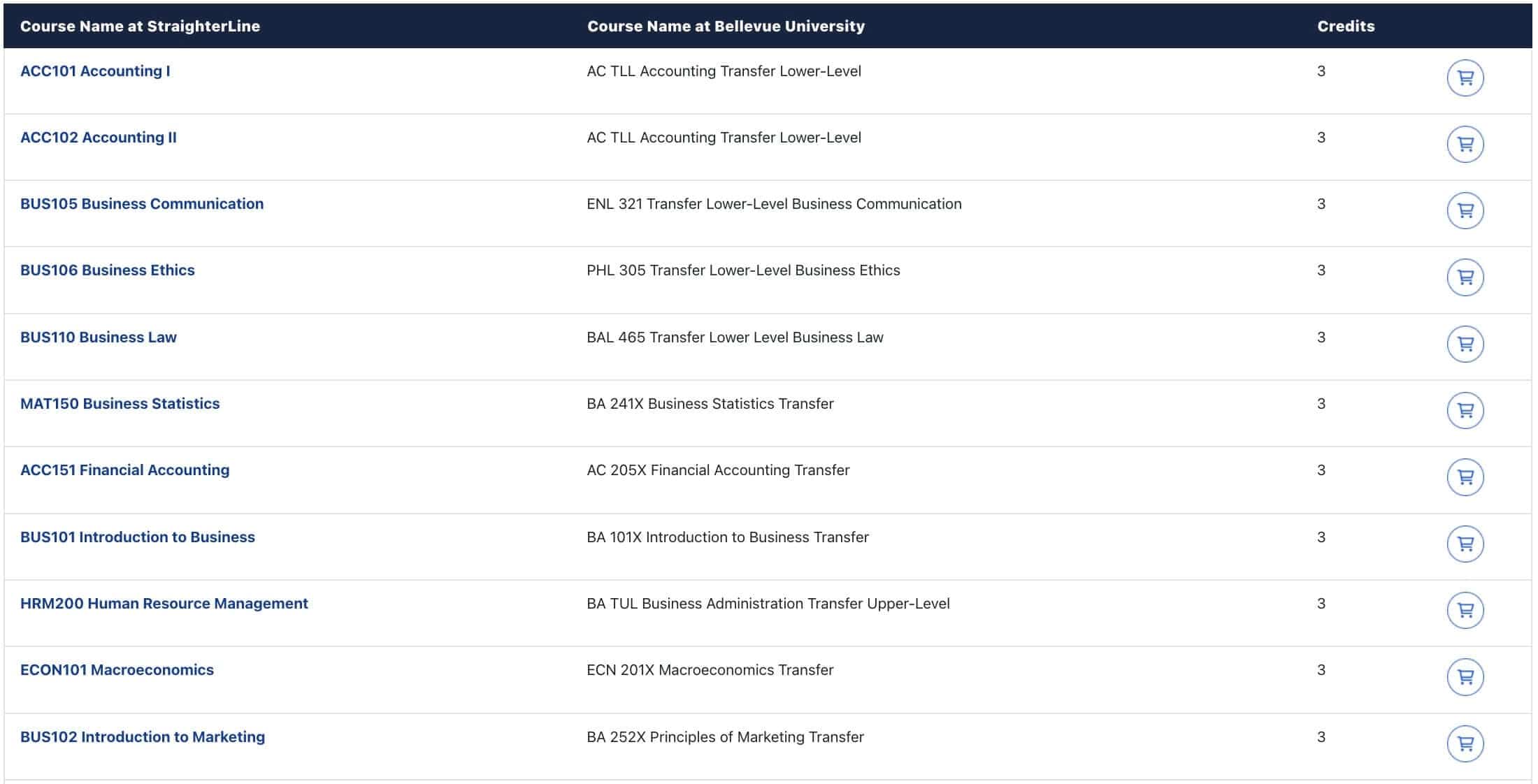
Check out this course equivalency guide, created through the articulation agreement between StraighterLine and Bellevue University.
The Different Types of Articulation Agreements
Not all articulation agreements look the same, and it helps to know which kind you're dealing with:
Course-to-course agreements, where a specific class at one school is matched directly to an equivalent class at another. Think of it as a one-for-one swap.
Program-to-program agreements, which are broader in scope and typically align an entire associate degree with the first two years of a related bachelor's degree, making the jump from a two-year to a four-year program more seamless.
Guaranteed admission or guaranteed transfer agreements, which go a step further by offering guaranteed acceptance, a reserved spot, or sometimes scholarship consideration to students who meet defined academic criteria, such as a minimum GPA or a completed set of courses.
Each type serves a slightly different purpose, so it's worth figuring out which kind of agreement applies to your situation before you build your course plan around it.
Why These Agreements Are Genuinely Useful for Students
Time. The most obvious benefit is time. When your courses are already mapped to a program's requirements, you're far less likely to end up retaking classes you've already passed, which keeps you moving toward graduation instead of circling back.
Savings. That efficiency translates directly into savings, too. Every course that transfers is a course you don't have to pay for twice, and for students who are budget-conscious, that can add up to real money saved over the course of a degree.
Better planning. There's also a planning advantage that's easy to overlook. When you know in advance how your coursework will apply, you can be intentional about what you take and when, rather than accumulating credits and hoping they'll be useful later.
Confidence. Transferring schools is stressful enough without wondering whether your transcript will hold up under review. An articulation agreement gives you something concrete to point to, which makes the whole process feel a lot less like a gamble.
Does an Agreement Guarantee Every Single Credit Transfers?
This is where a lot of students get confused, so it's worth addressing directly: an articulation agreement is not a guarantee. Even with an agreement in place, not every course you've taken will automatically transfer, and not every credit will necessarily satisfy every requirement in your new program.
A few things can affect this, including:
If you didn't meet the minimum grade requirement in a course, it may not qualify, even if the course itself is listed in the agreement.
If you change your major after enrolling, the courses that applied to your original program might not map as cleanly to a new one.
Some schools also have residency requirements, meaning you need to complete a certain number of credits at that institution regardless of how many you transfer in.
A course that transferred a couple of years ago isn't guaranteed to transfer under the current version of the agreement.
The practical takeaway here is simple: always check the most recent version of the agreement, and talk to an academic advisor before you register for courses, especially if you're planning several semesters ahead.
How to Find Out If Your Target School Has an Agreement in Place
Most colleges list their transfer partnerships on their admissions or transfer pages, and many maintain dedicated directories of partner institutions. Your school's registrar's office and academic advisors are also excellent resources, since they deal with these agreements regularly and can walk you through the specifics. If you're currently at a community college, the transfer office there is often a great starting point as well.
As you research, it helps to ask a few pointed questions:
Which degree programs does the agreement cover?
Which specific courses are included?
Is there a minimum GPA involved?
Are there deadlines or eligibility windows you need to be aware of?
A little research upfront can save you from unpleasant surprises down the road, and it puts you in a much stronger position to plan your coursework strategically.
Where StraighterLine Fits Into Your Transfer Plan
This is exactly the kind of planning StraighterLine was built to support. We partner with colleges and universities nationwide that evaluate our courses for transfer credit. That means you can complete eligible general education requirements affordably and on your own schedule before you ever set foot on campus, or while you're already enrolled elsewhere. Our courses are designed to be flexible enough to fit around whatever else is going on in your life, without sacrificing the academic rigor that receiving institutions expect.
One important note is that transfer credit acceptance is always determined by the receiving institution and its current policies, not by StraighterLine. That's exactly why we encourage students to explore our list of transfer partners and check the specifics for credit transfer before enrolling in any course!

Getting the Most Out of an Articulation Agreement
If you want to make an articulation agreement work as hard as possible for you, a little strategy goes a long way.
Start by choosing your intended transfer school as early as you reasonably can, since that gives you the clearest possible picture of which pathway to follow.
Make it a habit to verify the current details of the agreement rather than relying on something you read a while back, since these documents do get updated.
Take courses that align closely with your intended major, since electives that don't map to any requirement won't do you much good later on.
Keep an eye on grade requirements, since falling short in a single course can knock it out of eligibility even if it appears in the agreement.
Stay in regular contact with an academic advisor, both at your current school and your intended one, so you're always working from accurate, up-to-date information.
If you're looking for a lower-cost way to knock out some of your early requirements, take a look at StraighterLine's course catalog or check out our transfer guide. Many students use a combination of affordable online courses and careful planning to save real time and money on their degree.
Get Started on Your Transfer Pathway
Transfer articulation agreements exist to make the path between schools clearer and less stressful, giving you a real sense of how your coursework will apply to your degree before you enroll. Understanding how these agreements work, what they do and don't guarantee, and how to verify the details puts you in control of your own transfer story instead of leaving it up to chance.
If you're building your own path toward a degree and want an affordable, flexible way to knock out early requirements, take a look at StraighterLine's online courses.
With a little planning, you can turn a process that often feels uncertain into a clear, budget-friendly route to graduation.
FAQs
Are articulation agreements legally binding?
They're formal institutional agreements that spell out transfer policies, but they aren't guarantees in the way a contract might be. Students still need to meet the receiving school's academic and admissions requirements for the agreement to apply.
Do all colleges have articulation agreements?
No. Some schools maintain extensive networks of transfer partnerships, while others evaluate incoming coursework on a course-by-course basis without a formal agreement in place. It's always worth checking directly with the school you're interested in.
Can online courses be included in an articulation agreement?
Yes, in many cases. A growing number of agreements include eligible online college courses, provided they meet the receiving institution's standards. This is part of why platforms like StraighterLine can be such a useful piece of a transfer plan.
How do I know if my specific courses qualify?
The safest approach is to review the current agreement directly, reach out to the receiving institution, and confirm eligibility with an academic advisor before you register. Course lists and requirements can shift, so checking early saves headaches later.
What if there's no articulation agreement between my schools?
You can still transfer credits without one, but the process typically involves a more individualized review by the receiving institution. It may take longer, and outcomes can be less predictable, which is exactly the kind of uncertainty articulation agreements are designed to reduce.