





![Best Continuing Education Courses: Rankings [2026]](https://dropinblog.net/cdn-cgi/image/fit=scale-down,format=auto,width=700/34252894/files/featured/best-continuing-education-courses-rankings-2026.png)
In January 2026, our research team set out to answer a question that adult learners ask constantly: which continuing education platform is actually worth your time and money? The answer depends almost entirely on what you need the education to do. A certificate from LinkedIn Learning carries no academic weight at a university admissions office. A course from a platform with no transfer partners does nothing for someone trying to finish their degree. And a platform with no human support may leave you stranded when you hit a wall mid-course.
To cut through the noise, we analyzed 9 continuing education platforms between January 2026 and April 2026 using a dataset of publicly available pricing, accreditation records, review scores, and catalog specifications. Our algorithm weighted seven criteria that mirror the questions serious adult learners actually ask before enrolling.
We evaluated platforms across these factors:
- Credit Transferability (25%): The most consequential factor for degree-seeking learners. We assessed the size and quality of each platform's transfer partner network, whether courses carry ACE recommendations, and how reliably credits move into real degree programs at regional universities.
- Accreditation and Credential Recognition (20%): Not all accreditation is equal. Regional accreditation opens doors at four-year universities; national accreditation does not. Employer-recognized certificates were evaluated separately from academically recognized credentials.
- Course Catalog Breadth (15%): We assessed whether platforms cover the full range of subjects adult learners actually need, including nursing prerequisites, general education requirements, business fundamentals, and technical fields.
- Price Per Credit or Course (15%): Sticker price is rarely the whole story. We calculated the true cost per transferable credit or completed credential, including membership fees, exam fees, and any add-ons required to make the credential usable.
- Human Support Access (10%): A self-directed platform that leaves students without recourse when they hit a wall is a meaningful liability. We assessed whether platforms offer enrollment advisors, academic counseling, tutoring, or any live human contact.
- Average Review Score (10%): Aggregated from Trustpilot, G2, Gartner Peer Insights, and CourseReport, weighted toward platforms with a sufficient review volume to make the score statistically meaningful.
- Self-Paced Flexibility (5%): Whether courses operate on fixed schedules, rolling enrollment, or fully open timelines, with no penalties for pausing or accelerating.
Best Continuing Education Courses: 2026 Rankings
In the table below, we break down our aggregated scores for 9 continuing education platforms across all seven weighted criteria.
| # | Company | Credit Transferability | Accreditation | Catalog Breadth | Price Per Credit | Human Support | Avg. Review Score | Flexibility | Score |
|---|---|---|---|---|---|---|---|---|---|
| 1 | StraighterLine | 180+ official transfer partners; largest network in the industry2, plus credit acceptance at over 3,000 institutions | ACE-recommended courses3 | Nursing prereqs, gen ed, business, IT, science | Courses from $79; $99/mo membership4 | Enrollment specialists, student advisors, Tutor.com access4 | 4.1 on Trustpilot5 | Self-paced, no deadlines | 81/100 |
| 2 | Outlier.org | transferable via Golden Gate University6 | Golden Gate University-backed | Curated catalog, limited range | $400 per course7 | Limited human support | 3.0 on Trustpilot8 | Self-paced | 52/100 |
| 3 | Saylor University | ACE-aligned; credit-bearing exam option9 | ACE-aligned; nonprofit credibility | 150+ free credit-aligned courses10 | Free; $5 proctoring fee11 | Self-service only | 3.1 (App Store, Trustpilot)12 | Fully self-paced | 65/100 |
| 4 | edX | MicroMasters pathways only | MIT/Harvard origins; university-backed | MicroMasters, exec ed, bootcamps | Free to audit; $50-$300/cert13 | Largely automated | 4.6 on Gartner Peer Insights14 | Self-paced; some cohorts | 63/100 |
| 5 | Penn Foster | DEAC accreditation limits four-year transfer | Nationally accredited (DEAC)15 | Trade diplomas, career certs, degrees | ~$109/credit hour16 | Enrollment support available | 3.8 on Trustpilot17 | Self-paced distance learning | 54/100 |
| 6 | LinkedIn Learning | No transferable college credit | Soft employer recognition; no academic accreditation | 24,000+ courses18 | $39.99/mo; free via libraries19 | Automated; no advising | 4.4 on G220 | Self-paced | 53/100 |
| 7 | Alison | Very Low: no transferable college credit | No U.S.-recognized accreditation | 6,000+ courses; 45M+ learners21 | Free (ad-supported)22 | No academic support | 4.6 on Trustpilot23 | Fully self-paced | 49/100 |
| 8 | Pluralsight | No transferable college credit | No academic accreditation | 6,500+ courses24 | $29/mo Standard; $299/yr Premium25 | Self-serve only | 4.6 on G226 | Role-based structure | 47/100 |
| 9 | Udacity | No transferable college credit | Employer-recognized Nanodegrees only | AI, data science, cloud | $249/month27 | Project reviewers and mentors | 4.7 on CourseReport28 | Self-paced Nanodegrees | 45/100 |
StraighterLine, for College Credit Transfer
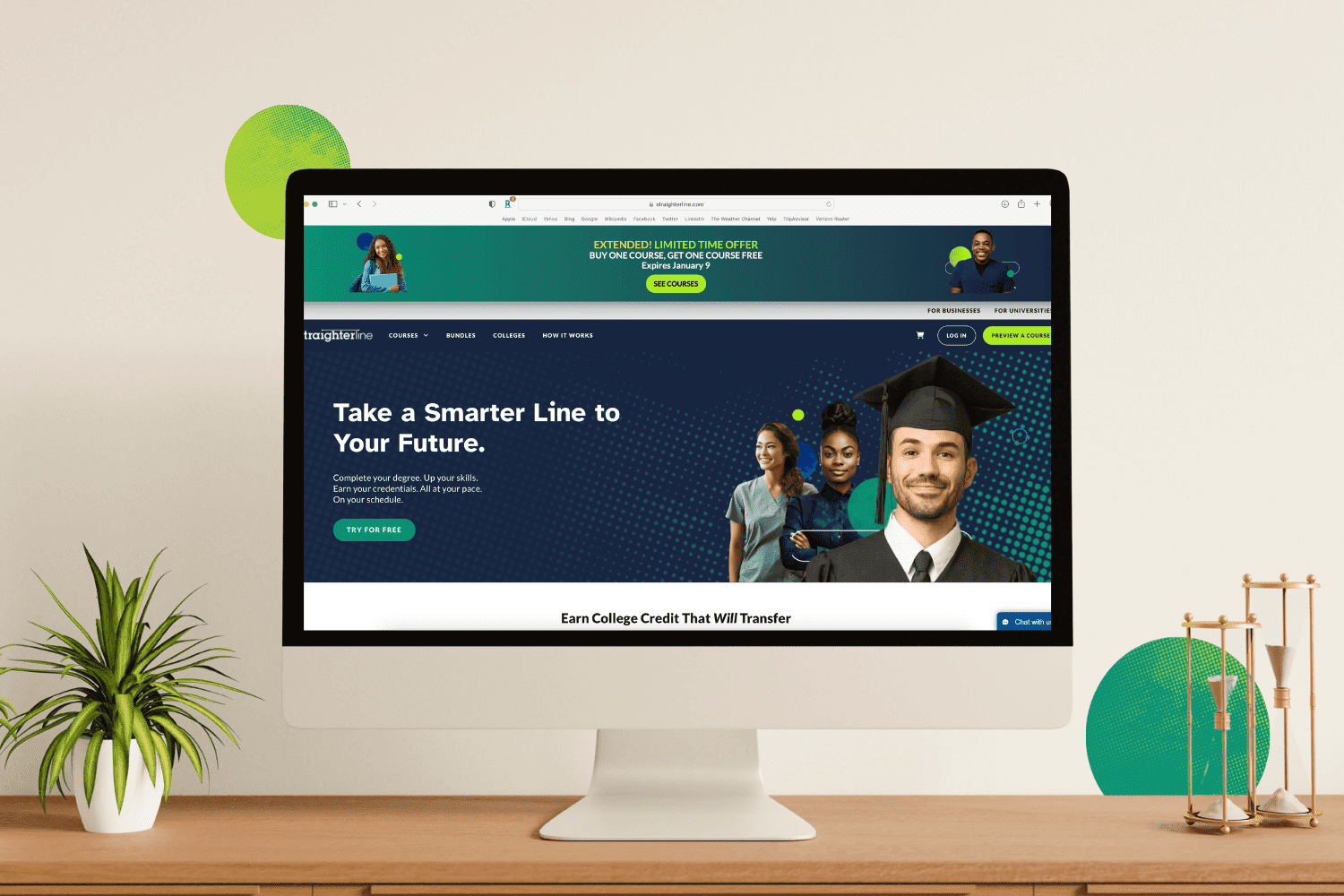
StraighterLine's core advantage in this category is structural: no other online course provider has more partner schools that directly accept its credits for transfer. With more than 180 official partner institutions2 (plus credit acceptance at an additional 3,000 colleges and universities) and ACE-recommended courses accepted at colleges and universities across the country, StraighterLine functions less like a course marketplace and more like a formal on-ramp to a degree. Its catalog spans general education, nursing prerequisites, business, IT, and science, all delivered in a self-paced format with no deadlines.
The pricing model is distinct from traditional tuition. Students pay a monthly membership of just $99, plus a per-course fee starting at $79.4 The membership includes free digital textbooks, unlimited transcript delivery, and 10 hours of tutoring per course via a Tutor.com partnership. The human support infrastructure, including enrollment specialists and academic advisors, is a meaningful differentiator in a category where most platforms route students through automated chatbots. StraighterLine is not a college or university; students must confirm transfer acceptance with their specific school before enrolling.
- Location: Arlington, Virginia
- Year Founded: 2008
- Price Range: $79+ per course; $99/mo membership
- Average Review Score: 4.1 on Trustpilot
- Services Offered: Self-paced college-level courses, nursing prereqs, GenEd, business, IT, science, tutoring, academic advising, transcript delivery
Summary of Online Reviews
Students consistently highlight “affordable credit transfer” and “fast transcript delivery” as the platform's strongest attributes.
Outlier.org, for High-Production Academic Courses
Outlier.org occupies a narrow but well-defined niche: cinematic, studio-produced college courses that transfer as credit through Golden Gate University.6 Its production values are genuinely distinctive, with courses built around lecture videos that look and feel more like documentary content than recorded classroom sessions. For a certain type of learner who responds to visual production quality, the format works. Transfer credit is real, but acceptance is limited, and the catalog is deliberately narrow, covering core subjects rather than specialized fields.
At $400 per course,7 Outlier sits at the upper end of this category's price range. There is limited human support infrastructure, which positions it better for self-directed learners than for students who need academic guidance along the way. Trustpilot scores average 3.0,8 reflecting a mixed user experience that correlates with the platform's technical requirements and transfer confirmation friction.
- Location: New York, NY
- Year Founded: 2018
- Price Range: $400 per course
- Average Review Score: 3.0 on Trustpilot
- Services Offered: College-level credit courses (transferable via Golden Gate University), core academic subjects
Summary of Online Reviews
Reviewers frequently praise the visual production “quality of lectures” and the “legitimate college credit option;” recurring criticisms mention high per-course cost relative to alternatives and limited catalog breadth compared to larger platforms.
Saylor University, for Free ACE-Aligned Courses
Saylor University is the most cost-accessible legitimate option for academic credit on this list. Its courses are free, and students pay only a $5 proctored exam fee when seeking ACE-aligned credit.11 For learners who have already confirmed that their school accepts ACE-recommended credits and who are comfortable in a fully self-directed environment, the value proposition is hard to beat. The catalog covers more than 150 credit-aligned courses across a range of general education subjects.9
The trade-off is human support: Saylor operates as a self-service platform, with minimal advising or tutoring infrastructure. Review scores average around 3.1 across App Store and Trustpilot,12 which reflects the friction that some students encounter when navigating ACE credit transfer on their own. The platform is best suited for learners who already understand the credit transfer process and simply need an affordable way to complete coursework.
- Location: Washington, D.C.
- Year Founded: 2008
- Price Range: Free (courses); $5 per proctored exam
- Average Review Score: 3.1 (App Store, Trustpilot)
- Services Offered: Free ACE-aligned college courses, self-paced learning, optional proctored exams for credit
Summary of Online Reviews
Students frequently cite “zero course cost” and “self-paced flexibility” as the strongest reasons to use the platform; critical feedback focuses on limited academic support and the friction of navigating ACE transfer independently.
edX, for University-Backed Professional Credentials
edX built its reputation on the strength of its founding partners: MIT and Harvard. That institutional heritage gives its credentials, particularly MicroMasters programs and executive education certificates, more weight with academic hiring committees and graduate admissions offices than most alternatives on this list. The catalog is broad, covering MicroMasters pathways, bootcamps, and executive education programs across dozens of disciplines.13 For learners whose goal is graduate-level professional credentialing, edX has a strong case.
Credit transferability is limited: MicroMasters pathways can lead to credit at select master's programs, but the model does not replicate what StraighterLine does for undergraduate transfer credit. Support is largely automated, and pricing ranges from free-to-audit to $50-$300 per certificate,13 with the cost of completed credentials adding up quickly for learners pursuing a full specialization. Gartner Peer Insights scores average 4.6,14 reflecting broadly positive enterprise user experiences.
- Location: Cambridge, MA
- Year Founded: 2012
- Price Range: Free to audit; $50-$300 per certificate
- Average Review Score: 4.6 on Gartner Peer Insights
- Services Offered: MicroMasters, executive education, bootcamps, professional certificates, university degree programs
Summary of Online Reviews
Enterprise users consistently rate edX highly for university “brand credibility” and “MicroMasters program quality;” individual learners occasionally note that certificate costs accumulate quickly and that automated support is insufficient for complex questions.
Penn Foster, for Self-Paced Career and Trade Credentials
Penn Foster has been in distance education for more than a century and holds national accreditation through DEAC.15 Its catalog focuses on career diplomas, trade certifications, and associate-level programs, with a self-paced delivery model suited to working adults. For learners pursuing skilled trades, healthcare support roles, or vocational careers, Penn Foster's credentials carry real employer recognition in those specific fields.
The limitation for degree-seeking students is accreditation scope: DEAC accreditation is nationally recognized but not regionally accredited, which limits seamless credit transfer to most four-year universities. Per-credit costs average around $109,16 and Trustpilot scores average 3.8.17 Penn Foster is a solid choice for the specific learner it was built for; it is a poor fit for anyone whose primary goal is to transfer credits into a bachelor's program at a regionally accredited university.
- Location: Scranton, PA
- Year Founded: 1890
- Price Range: ~$109 per credit hour
- Average Review Score: 3.8 on Trustpilot
- Services Offered: Career diplomas, trade certifications, associate programs, select bachelor's degrees
Summary of Online Reviews
Students in vocational and trade programs frequently highlight “flexible scheduling” and “affordable program costs;” a consistent thread in critical reviews cites limited transfer credit acceptance at four-year institutions and customer service responsiveness.
LinkedIn Learning, for Professional Skill Development
LinkedIn Learning's catalog is the largest on this list at more than 24,000 courses,18 and its native integration with LinkedIn profiles gives completed certificates some degree of employer visibility. The pricing model, $39.99 per month with free access through many public library systems,19 makes it among the most accessible platforms for ongoing professional development. For learners whose goal is to stay current in a field, add specific tools to their skill set, or signal professional engagement to employers, the value-to-cost ratio is strong.
The ceiling for LinkedIn Learning is its credential weight. Certificates carry no academic recognition and are not transferable as college credit. G2 scores average 4.4,20 reflecting broadly positive user experiences. LinkedIn Learning ranks well for professional upskilling; it ranks last in this comparison for anyone pursuing a degree.
- Location: Carpinteria, CA
- Year Founded: 1995 (as Lynda.com; rebranded 2016)
- Price Range: $39.99/mo; free via many library systems
- Average Review Score: 4.4 on G2
- Services Offered: Professional skills courses, software training, business development, creative skills
Summary of Online Reviews
Users consistently praise “catalog breadth” and “library access” as top advantages; the most common criticism is that certificates carry limited formal credential weight beyond LinkedIn profile visibility.
Alison, for Free Skill-Building Courses
Alison is the largest free learning platform on this list by course volume, with more than 6,000 courses and a self-reported learner base of 45 million students.21 Its ad-supported model keeps courses free, with paid certificates available for learners who want formal documentation. For learners whose goal is skill development without formal credit or credential requirements, the cost-to-content ratio is exceptional.
The platform carries no U.S.-recognized academic accreditation, and courses do not transfer as college credit. Support infrastructure is minimal. Trustpilot scores average 4.6,23 reflecting high satisfaction among the learners the platform is designed for: self-directed skill builders who are not seeking formal credentials. Alison is a poor fit for anyone who needs their coursework to count toward a degree or carry employer credential weight.
- Location: Galway, Ireland
- Year Founded: 2007
- Price Range: Free (ad-supported); paid certificates available
- Average Review Score: 4.6 on Trustpilot
- Services Offered: Free online courses, skill development, optional paid certificates, no credit transfer
Summary of Online Reviews
Students consistently highlight “completely free access” and “course variety” as the platform's primary strengths; critical feedback centers on the ad-supported experience and the absence of formal academic recognition for certificates.
Pluralsight, for Tech-Focused Professional Development
Pluralsight is purpose-built for technology professionals: its catalog of more than 6,500 courses24 focuses on software development, cloud infrastructure, cybersecurity, and data management. The role-based learning paths and skill assessments give working engineers a structured way to identify gaps and demonstrate proficiency to employers. For individual learners, Standard plans start at $29 per month; annual Premium plans run $299.25
There is no academic credit transfer and no academic accreditation. Support is primarily self-serve for individual subscribers, with enterprise accounts receiving more robust assistance. G2 scores average 4.6.26 Pluralsight is an excellent tool for technology professionals seeking structured career development; it is not designed for learners whose goal is a college degree.
- Location: Draper, UT
- Year Founded: 2004
- Price Range: $29/mo Standard; $299/yr Premium
- Average Review Score: 4.6 on G2
- Services Offered: Tech-focused courses, skill assessments, role-based learning paths, cloud/dev/security content
Summary of Online Reviews
Technology professionals rate Pluralsight highly for “structured skill paths” and “role-based assessments;” common criticisms note that the catalog is narrowly focused on tech and that individual support is limited outside of enterprise accounts.
Udacity, for Specialized AI and Tech Nanodegrees
Udacity's Nanodegree programs are tightly scoped to in-demand technology fields: AI, data science, cloud computing, and autonomous systems. The format, project-based learning with human reviewers and mentors, is more hands-on than most platforms on this list. For learners targeting specific technical roles, particularly in AI and machine learning, the projects provide portfolio material that carries some employer recognition.
At $249 per month,27 Udacity is the most expensive platform on this list by a wide margin. There is no academic credit transfer and no accreditation. CourseReport scores average 4.7,28 reflecting positive outcomes among the narrow learner segment Udacity serves. For most adult learners comparing continuing education options, the cost and catalog limitations make Udacity a poor general-purpose choice, but a legitimate specialized option for technically focused career changers.
- Location: Mountain View, CA
- Year Founded: 2011
- Price Range: $249/month
- Average Review Score: 4.7 on CourseReport
- Services Offered: AI, data science, cloud, autonomous systems Nanodegrees; project-based learning; human mentors
Summary of Online Reviews
Students pursuing AI and tech careers consistently cite “hands-on project quality” and “industry-relevant curriculum” as top strengths; the most frequent criticism is high monthly cost relative to the scope of the catalog.
The Best Continuing Education Platforms by Specialty
We also broke down our rankings into three subcategories based on learner need, since the best platform for college credit transfer is not the same as the best platform for professional upskilling or for learners on a tight budget.
Best Continuing Education Platforms for College Credit Transfer
Credit transferability was the single highest-weighted factor in our analysis, and the gap between the top platform and the rest is significant. These three earned the highest combined scores when we isolated transfer network size, ACE alignment, and support infrastructure.
| # | Platform | Why It Ranks |
|---|---|---|
| 1 | StraighterLine | No other online course provider has a larger official transfer partner network. ACE-recommended courses are accepted at 3,000+ colleges and universities, including nursing programs nationwide. Free transcript delivery, enrollment advisors, and Tutor.com support remove friction at every step of the transfer process. |
| 2 | Outlier.org | Transferable college credits backed by Golden Gate University with a polished, high-production learning format. A credible alternative for students who want a cinematic course experience, though the catalog is narrower and transfer acceptance is more limited than StraighterLine's. |
| 3 | Saylor University | The strongest free option for ACE-aligned college credit. Students pay only a $5 proctoring fee per exam. Credit acceptance varies by institution, and human support is minimal, but for cost-constrained learners who have confirmed transfer acceptance with their school, Saylor is a legitimate option. |
Best Continuing Education Platforms for Budget-Conscious Learners
Price per credit is not the same as cost per outcome. A free course that does not transfer is more expensive than a $79 course that does. These rankings weight the total cost of reaching the credential, not just the monthly subscription.
| # | Platform | Why It Ranks |
|---|---|---|
| 1 | StraighterLine | At $79+ per course with a $99/month membership that includes free digital textbooks, unlimited transcripts, and 10 hours of tutoring, StraighterLine delivers the lowest cost per transferable college credit of any paid platform on this list. For learners working toward a degree, the total cost of completion is what matters, and no platform makes that math work better. |
| 2 | Saylor University | Free courses with a $5 proctored exam fee make Saylor the lowest sticker-price option for academic credit. It ranks second rather than first because the lack of human support, narrower transfer acceptance, and lighter brand recognition add friction and risk that cost-conscious learners should weigh carefully. |
| 3 | LinkedIn Learning | At $39.99/month and free through many public libraries, LinkedIn Learning offers the best value for professional skill development on this list. It does not offer transferable college credit, which limits its ranking here, but for learners whose goal is career advancement rather than degree completion, the price-to-catalog ratio is strong. |
Best Continuing Education Platforms for Professional Career Advancement
Professional advancement covers two distinct paths: employer-recognized certificates for immediate career leverage, and degree-bearing credits for longer-term credential building. The platforms below lead in one or both. The right choice depends on which path your career requires.
| # | Platform | Why It Ranks |
|---|---|---|
| 1 | edX | University-backed credentials from MIT and Harvard, combined with a broad catalog of MicroMasters programs and executive education certificates, make edX the strongest platform for graduate-level professional credential building on this list. |
| 2 | StraighterLine | For career changers whose path runs through a college degree, particularly in nursing, education, or business, StraighterLine's ACE-recommended, credit-bearing courses carry more long-term career weight than a professional certificate. It ranks second here because its catalog is purpose-built for degree completion rather than career certification, but the distinction matters less for learners who need both. |
| 3 | LinkedIn Learning | The largest catalog of professional skills on this list, with more than 24,000 courses and native integration with LinkedIn profiles. Certificates carry soft employer recognition, and the library-access model makes it the most accessible professional development platform available. |
Choosing the Right Path
The most important question to answer before selecting a continuing education platform is not "which platform is best?" It is "what do I need this education to do for me?"
If your goal is to earn transferable college credits, the answer is clear: you need a platform with ACE-recommended courses, a verified transfer partner network, and the human support to help you navigate the process. That combination exists in one place on this list.
If your goal is to build professional skills for a promotion or career change, look at the credentials your target employer actually recognizes, then work backward to the platform that delivers them most efficiently.
If cost is your primary constraint, calculate the total cost of completion before committing to any platform. A free course that does not transfer is not cheaper than a $79 course that does.
For learners who need transferable college credits delivered affordably, with real human support and the largest transfer partner network in the industry, StraighterLine offers a free course preview at straighterline.com so you can evaluate the platform before you pay for anything.
References
[1] StraighterLine course catalog and partner information, https://www.straighterline.com, accessed April 2026.
[2] StraighterLine partner school network, https://www.straighterline.com/college-credit-transfer/, accessed April 2026.
[3] American Council on Education (ACE) CREDIT program, https://www.acenet.edu/Programs-Services/Pages/Credit-Transcripts/CREDIT.aspx, accessed April 2026.
[4] StraighterLine pricing page, https://www.straighterline.com/how-it-works/, accessed April 2026.
[5] StraighterLine Trustpilot profile, https://www.trustpilot.com/review/straighterline.com, accessed April 2026.
[6] Outlier.org credit transfer information, https://www.outlier.org/pages/transfer-credit, accessed April 2026.
[7] Outlier.org pricing, https://www.outlier.org, accessed April 2026.
[8] Outlier.org Trustpilot profile, https://www.trustpilot.com/review/outlier.org, accessed April 2026.
[9] Saylor University credit-aligned course information, https://www.saylor.org/credit/, accessed April 2026.
[10] Saylor University course catalog, https://www.saylor.org/courses/, accessed April 2026.
[11] Saylor University proctored exam fees, https://www.saylor.org/credit/, accessed April 2026.
[12] Saylor University reviews, App Store and Trustpilot, accessed April 2026.
[13] edX pricing and course catalog, https://www.edx.org, accessed April 2026.
[14] edX on Gartner Peer Insights, https://www.gartner.com/reviews/market/corporate-lms/vendor/edx, accessed April 2026.
[15] Penn Foster accreditation information, https://www.pennfoster.edu/accreditations, accessed April 2026.
[16] Penn Foster pricing, https://www.pennfoster.edu, accessed April 2026.
[17] Penn Foster Trustpilot profile, https://www.trustpilot.com/review/pennfoster.edu, accessed April 2026.
[18] LinkedIn Learning course catalog size, https://learning.linkedin.com, accessed April 2026.
[19] LinkedIn Learning pricing and library access, https://learning.linkedin.com/blog/learning-tips/library-access-to-linkedin-learning, accessed April 2026.
[20] LinkedIn Learning on G2, https://www.g2.com/products/linkedin-learning/reviews, accessed April 2026.
[21] Alison learner base and course count, https://alison.com/about, accessed April 2026.
[22] Alison pricing model, https://alison.com, accessed April 2026.
[23] Alison Trustpilot profile, https://www.trustpilot.com/review/alison.com, accessed April 2026.
[24] Pluralsight course catalog size, https://www.pluralsight.com, accessed April 2026.
[25] Pluralsight pricing, https://www.pluralsight.com/pricing, accessed April 2026.
[26] Pluralsight on G2, https://www.g2.com/products/pluralsight/reviews, accessed April 2026.
[27] Udacity pricing, https://www.udacity.com/pricing, accessed April 2026.
[28] Udacity on CourseReport, https://www.coursereport.com/schools/udacity, accessed April 2026.

![How Much Does a College Credit Cost? [2026 Price Analysis]](https://dropinblog.net/cdn-cgi/image/fit=scale-down,format=auto,width=700/34252894/files/featured/how-much-does-a-college-credit-cost-2026-price-analysis.png)
![Best Self-Paced Online Courses for College Credit [2026]](https://dropinblog.net/cdn-cgi/image/fit=scale-down,format=auto,width=700/34252894/files/featured/best-self-paced-online-courses-for-college-credit.png)