





Going back to algebra as an adult can be intimidating. You may recognize the formulas, symbols, and terminology from school, but remembering how to actually use them is another matter.
The good news is that you’re not necessarily starting from scratch. As an adult, you’ve spent years solving problems and using math in practical situations — whether that means managing a budget, comparing costs, measuring materials, or working with numbers on the job. Those experiences can work as useful context as you relearn algebra.
For many adults returning to college, college algebra is part of their degree requirements. The course builds on basic math and introductory algebra skills and typically moves into topics such as equations, functions, graphs, exponents, and polynomials. If it’s been years since you last worked with those concepts, knowing what to review and how to approach the course differently this time can make the transition much easier.
This guide walks through what to expect, what algebra actually requires, and how to set yourself up for a good outcome.
Is Algebra Hard for Adults?
Algebra can be challenging if it's been a while since your last math class, but being older doesn't make algebra itself harder. What usually makes it feel harder is the long break from math class rather than your ability to learn. In fact, the reasoning and problem-solving skills you've built since high school often work in your favor.
Why algebra can feel difficult when you're returning to school
A few things tend to show up when adults return to math:
It's been years since your last math course, so terms and steps that used to be automatic now take extra thought.
Fundamentals like fractions, negative numbers, or order of operations have gotten harder to use.
Math anxiety creeps in before you've even started your coursework.
Old study habits like memorizing rules instead of practicing problems don't hold up at the college level.
Work, family, and other responsibilities compete for the time you'd like to spend studying.
It's worth separating two different things: algebra itself, and the experience of returning to structured academic math after time away. Most of what feels hard falls into the second category, and that part is very fixable with the right approach.
Is Algebra Easier to Learn as an Adult?
In many ways, yes. Adults returning to algebra aren't usually starting from zero, even if it can feel that way at first.
You've seen algebra before
If you took algebra in high school, the core concepts and vocabulary are still the same — they just need a refresh. Algebra hasn't changed since you last studied it, and with review and practice, the rules and notation may come back faster than students expect.
You already use algebra in everyday life
A lot of adult life runs on algebra. Common applications include:
Managing a budget or figuring out take-home pay
Measuring a room for flooring or calculating materials for a project
Comparing unit prices while shopping
Estimating drive time based on distance and speed
Calculating tips, interest, or discounts
Solving problems on the job in fields like construction, healthcare, or logistics
You can connect abstract math to real problems
This is one of the biggest advantages adults have over younger students. When an algebra problem asks you to solve for an unknown quantity, you've likely already done something similar like estimating a project cost, adjusting a recipe, or working out a schedule. That instinct for problem-solving gives you a head start once the symbols get involved.
What Math Skills Do You Need Before Taking College Algebra?
It helps to know where you stand before the course starts. Most college algebra classes assume you’re comfortable with:
Addition, subtraction, multiplication, and division
Fractions and decimals
Negative numbers
Order of operations
Ratios and percentages
Basic equations
Exponents
You don't need to be proficient in every one of these before you start, but more gaps mean that college algebra can feel harder. A quick, honest self-check now can save a lot of frustration later.
What if you've forgotten most of your math?
If it's been a long time, or if that list felt more unfamiliar than familiar, a refresher or introductory algebra course is usually a smarter first move. Building a solid base first tends to be faster in the long run than trying to learn two levels of math at once.
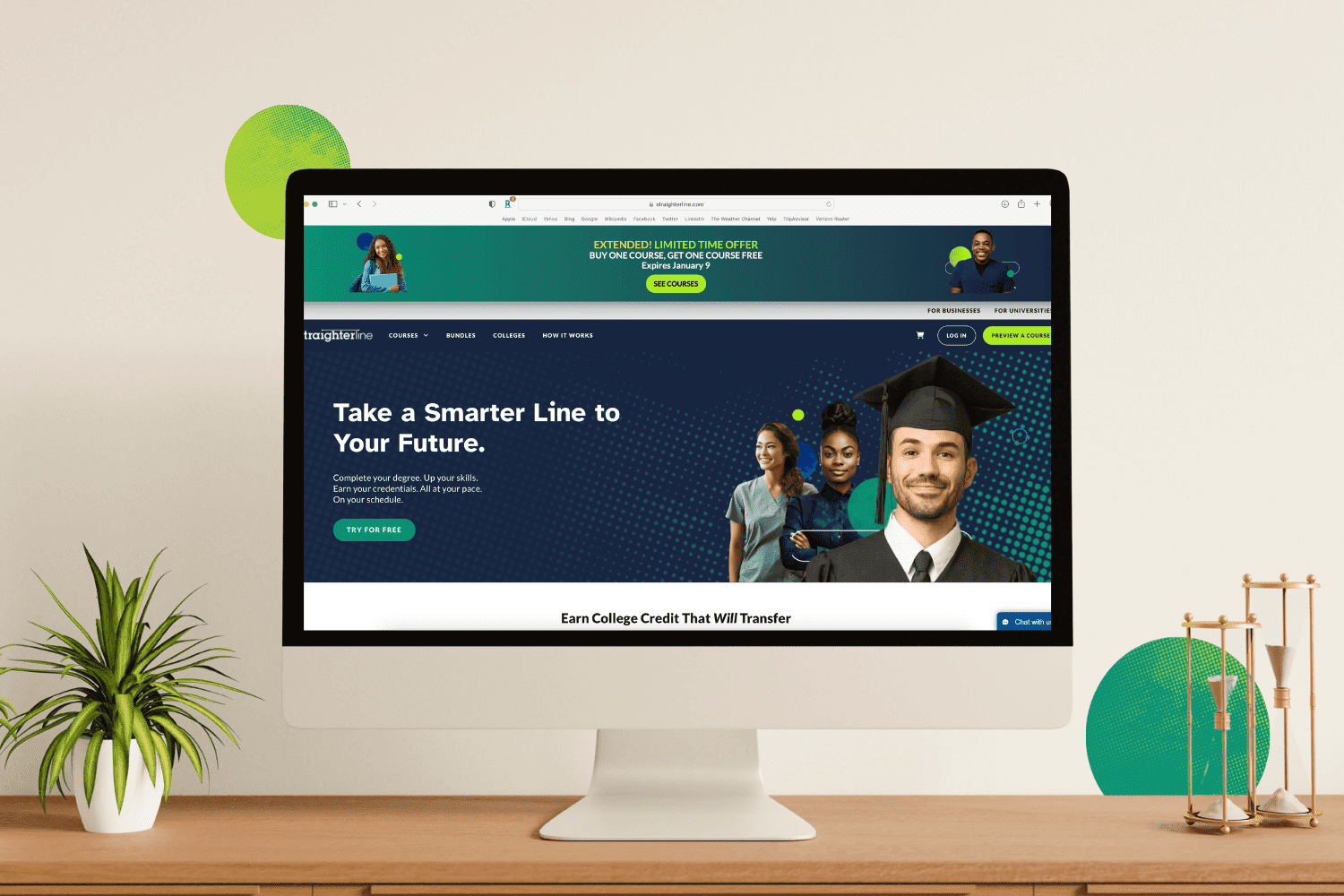
StraighterLine's Introductory Algebra course is built for exactly this — it covers the basics using real-life scenarios and has no prerequisites, so you can start wherever you are.
What Do You Learn in a College Algebra Class?
Course content varies somewhat by school, but most college algebra classes cover a similar core:
Algebraic expressions and equations — writing and solving for unknown values
Inequalities — comparing values that aren't necessarily equal
Functions — rules that connect one value to another
Graphing — visualizing relationships between numbers on a coordinate plane
Linear equations — equations that graph as straight lines
Systems of equations — solving multiple equations that share variables
Polynomials — expressions built from variables raised to whole-number powers
Rational expressions — fractions that contain variables
Exponents and radicals — powers and roots, including simplifying them
Exponential and logarithmic functions — growth, decay, and their inverse relationships
Courses build from simpler operations toward more advanced applications, so each topic supports the next.
What Are the Biggest Challenges Adults Face in Algebra?
Adult learners often face a few common challenges when returning to algebra. Below are some of the most common challenges we see among StraighterLine students.
1. Math anxiety
Stress about math can interfere with actual performance, particularly on quizzes and exams where you need quick recall. Slowing down, practicing under low-pressure conditions, and giving yourself credit for progress can all help keep anxiety from taking over.
2. Gaps in foundational math skills
If arithmetic, fractions, or basic equations are not easy, algebra will feel harder than it needs to. This connects directly back to the readiness skills above — closing those gaps first pays off throughout the course.
3. Ineffective study habits
Memorizing a rule and being able to apply it are two different skills. Algebra rewards students who work through problems by hand, not just students who reread notes.
4. Avoiding difficult problems
It's tempting to stick with the problems that already make sense. But skipping the harder ones leaves you underprepared for exams.
5. Finding enough time to practice
Adult students are often balancing coursework with a job, family, or both. Consistent, shorter study sessions tend to fit real schedules better than trying to find large blocks of free time that may never appear.
6. Getting discouraged after mistakes
A wrong answer isn't a sign that algebra "isn't for you" — it's information. Students who treat mistakes as a normal part of learning, rather than a setback, tend to recover faster and keep moving forward.
How Can Adults Get Better at Algebra?
A few consistent habits make a measurable difference.
Practice algebra instead of only reading about it. Watching someone else solve a problem is not the same as solving one yourself. Working through problems by hand builds the muscle memory algebra depends on.
Review mistakes instead of just checking the answer. When you get something wrong, take a minute to figure out why. Was it a calculation slip, a misunderstood step, or a concept you haven't fully learned yet? That answer tells you what to study next.
Practice difficult problems, not just easy ones. Challenging problems are where the real learning and exam preparation happens.
Study in shorter, consistent sessions. Thirty focused minutes a few times a week is often more effective than one long session that leaves you exhausted and less able to retain what you covered.
Ask for help early. Reaching out the moment something stops making sense is far more effective than waiting until right before a test. Free tutoring, like the support included in StraighterLine's math courses, exists for exactly this reason.
Use practice quizzes to identify weak areas. Practice quizzes aren't just a formality — they're a diagnostic tool that shows you exactly where to focus your remaining study time.
How Much Time Should You Spend Studying Algebra?
There isn't a single number of study hours that works for every student. How much time you need depends on:
Your current math skills
The pace of your course
How familiar the topic already feels
The difficulty of the specific concept you're working through
What matters more than the exact number of hours is the pattern: frequent, regular practice generally beats a single long cram session, because algebra skills build on each other and need repetition to stick.
How Is Algebra Used in Real Life?
Algebra shows up more often than most people realize.
Personal finance. Budgeting, calculating interest, comparing loan terms, and tracking income and expenses all rely on algebraic thinking.
Careers and the workplace. Fields like construction, healthcare, business, technology, and logistics use algebra regularly, whether it's measuring materials, calculating dosages, analyzing data, or managing inventory.
Everyday problem solving. Estimating travel time, comparing prices, adjusting a recipe, or splitting a bill are all small acts of algebra.
This is part of why adults often adapt to algebra faster than they expect — many of them already understand the underlying problem, even if they've never called it “algebra.”
Why Is College Algebra Required?
College algebra commonly fulfills a general education math requirement. It builds quantitative reasoning skills that carry into later coursework — particularly in science, business, and technical fields — and it strengthens the kind of logical, step-by-step thinking that shows up well beyond the math classroom.
Not every degree program requires it, so it's worth confirming your program's specific requirements, but for many students it's a foundational course.
Can You Take College Algebra Online?
Yes. College algebra is widely available online, which means you can study on your own schedule instead of around a fixed classroom time. That said, course format, pacing, instructor support, exam structure, and transfer policies vary quite a bit from one platform to the next, so it's worth looking closely before you enroll.
When evaluating an online algebra course, look for:
Flexible, self-paced scheduling
Plenty of opportunities to practice
Clear, well-organized explanations
Real academic support, not just prerecorded videos
College credit eligibility
Transferability of that credit to your degree program
StraighterLine's College Algebra course is built around these priorities — self-paced study, free tutoring, and credits that have transferred to thousands of schools — so you can move through the material on a schedule that actually fits your life.
Use the Find Your College tool to see if your school is one of the 3,000+ colleges and universities that accepts StraighterLine credits.
Should You Take Introductory Algebra Before College Algebra?
For some students, yes. There's no downside to building a stronger foundation first, outside of the additional cost and study hours. Introductory algebra tends to be a good move if you:
Haven't taken algebra in many years
Struggle with basic equations
Need to review fractions, negative numbers, or exponents
Want to rebuild confidence before jumping into college-level math
Starting with the fundamentals isn't a detour if you need it. It's often the fastest path to actually succeeding once you reach College Algebra, rather than struggling through it.
→ Get started with Introductory Algebra
How to Prepare for an Algebra Class as an Adult
Assess your current math skills
Review arithmetic and introductory algebra concepts
Identify the specific areas you've forgotten
Set a regular, realistic study schedule
Practice solving problems by hand, not just reading through them
Review incorrect answers to understand why they were wrong
Ask for help as soon as you're stuck
Use practice quizzes before exams to find weak spots early
Take Online Algebra With StraighterLine
Algebra is learnable as an adult! You may need to refresh some old skills — and that's expected, not a setback. What matters most is consistent practice and a willingness to ask for help when something doesn't click right away.
If you're ready to get started, StraighterLine's Introductory Algebra and College Algebra classes are both self-paced, come with free tutoring, and are designed for adult students who want to build math skills on a schedule that actually works with life.

FAQs
Can adults learn algebra if they were bad at math in school?
Yes. Struggling with math years ago doesn't determine how you'll do now. Reviewing foundational skills, practicing consistently, and addressing gaps as they come up can make returning to math far more manageable than it was the first time around.
How do I relearn algebra after many years?
Start by reviewing arithmetic fundamentals and basic algebra, then move into equations, functions, and graphing as those come back to you. Practice problems are the fastest way to find out exactly which skills need the most attention.
Do I need to memorize formulas to pass algebra?
Some formulas and rules do need to become familiar, but memorization on its own usually isn't enough. Algebra asks you to apply those rules to new and unfamiliar problems, which is why practice matters as much as memorization.
Can I learn algebra on my own?
Many algebra concepts can be learned independently, especially with structured lessons, worked examples, plenty of practice problems, and access to help when you need it — which is exactly how self-paced courses are designed to work.
Is online algebra a good fit for adult learners?
Often, yes, particularly if scheduling flexibility matters to you. Look closely at the course structure, the support that's available, the pacing, and whether the credit will meet your academic and transfer needs before you commit.
![Best Online College Algebra Courses for College Credit [2026 Rankings]](https://dropinblog.net/cdn-cgi/image/fit=scale-down,format=auto,width=700/34252894/files/featured/best-online-college-algebra-courses-for-college-credit.png)